The key to this puzzle is understanding how gravity affects speed as someone travels down a slide.
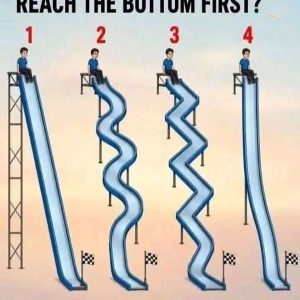
Let’s start with person number 3. This slide has a zigzag shape with several sharp changes in direction. Depending on the slide’s construction, those turns may introduce additional friction and energy loss, making the journey slower.
Person number 2 has a wavy slide with several curves. Although smoother than the zigzag design, the repeated changes in slope can affect acceleration and travel time.
Now consider person number 1.
This person has a straight slide running directly from the top to the bottom. It appears to be the shortest route, which makes it a tempting choice.
But the surprising part comes when we examine person number 4.
Slide number 4 begins with a particularly steep drop before gradually becoming flatter near the bottom.
This shape allows the rider to accelerate quickly at the beginning, gaining speed earlier than someone traveling down a more gradual straight incline.
In physics, a related principle is known as the brachistochrone problem.
It describes the curve along which an idealized object traveling under gravity can move between two points in the shortest possible time.
The fastest route is not necessarily a straight line. Under ideal conditions, a carefully shaped curve that drops steeply at first can beat a direct incline.
That’s why the puzzle identifies person number 4 as the intended winner.
However, real playground slides also involve friction, body position, and other factors. Without exact measurements, the illustration alone cannot establish a guaranteed real-world result.
Still, the puzzle demonstrates a fascinating lesson: sometimes gaining speed early matters more than traveling the shortest distance.
The intended answer is number 4!
Did you choose number 4 immediately, or did you think the straight slide would win? Tell us your first answer in the comments!


This Post Has One Comment